Narrative laundering: Kremlin disinformation reaches AI through China and fake Spanish news sites
Before Spain's election on 29 November, fake local news sites of a network run from China publish machine translations of Kremlin media
- Occasion: Spain's general election, 29 November 2026
- Data: 20,996 posts of 14 sites, read on 21 November 2026
- AI assistants: questions in Spanish, 21 and 22 November 2026
- Authors: Dosimeter, an independent research group from Berlin
1 · Key findings
Narrative laundering in the local news of Spain
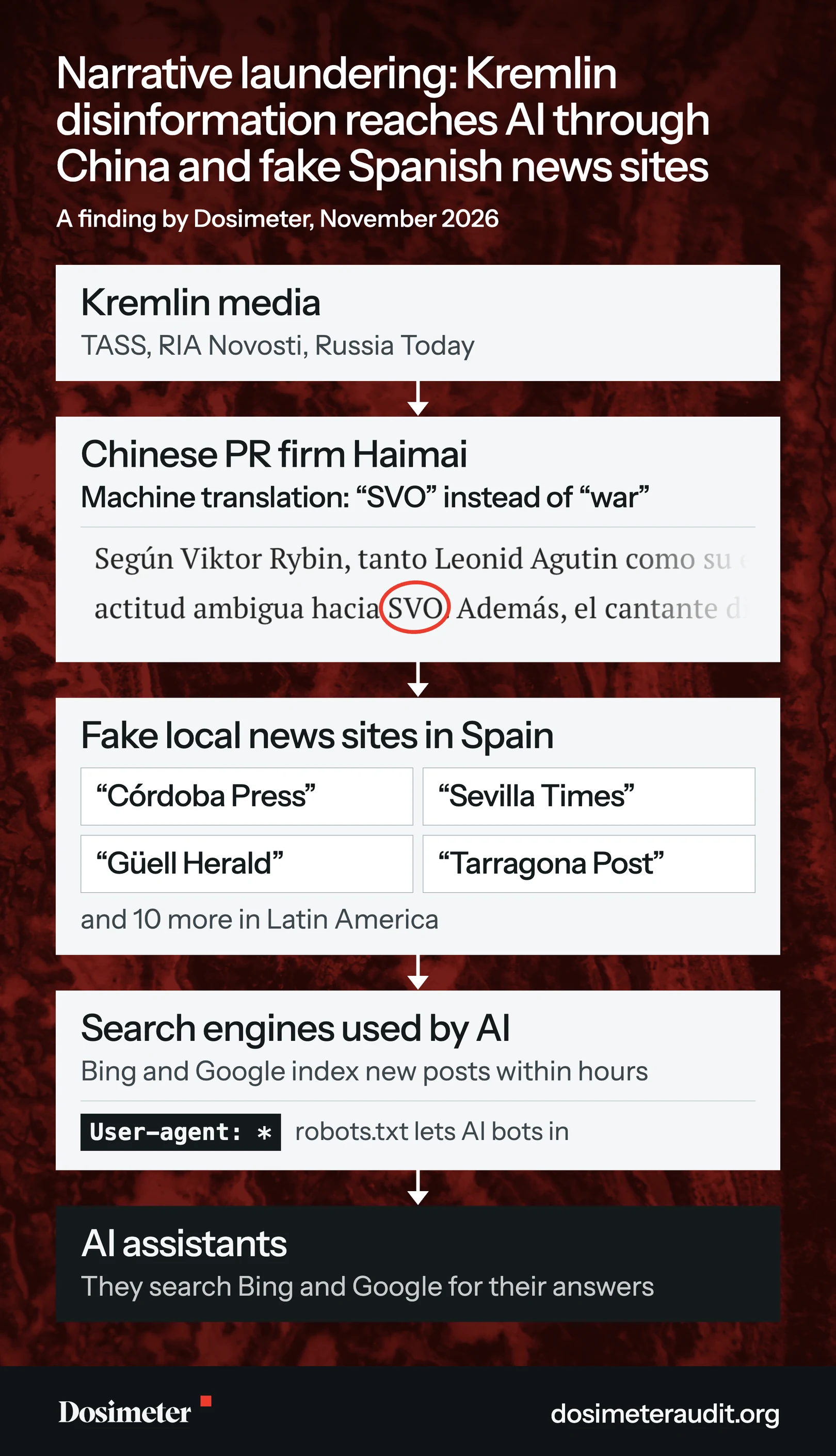
Kremlin disinformation reaches Spanish readers under the names of local news sites. The European External Action Service (EEAS), the diplomatic service of the EU, calls the method of this network laundering1. “Slopeño” is Dosimeter's name for 14 such websites in Spanish.
They belong to Paperwall, a network that Citizen Lab linked to the Chinese PR firm Haimai in 20243. Four pose as local news outlets of Córdoba, Barcelona, Seville and Tarragona, and ten as local news outlets in Latin America.
- 13.1% to 25.7% of a site's posts have a Russian source, such as RIA Novosti, TASS or Russia Today
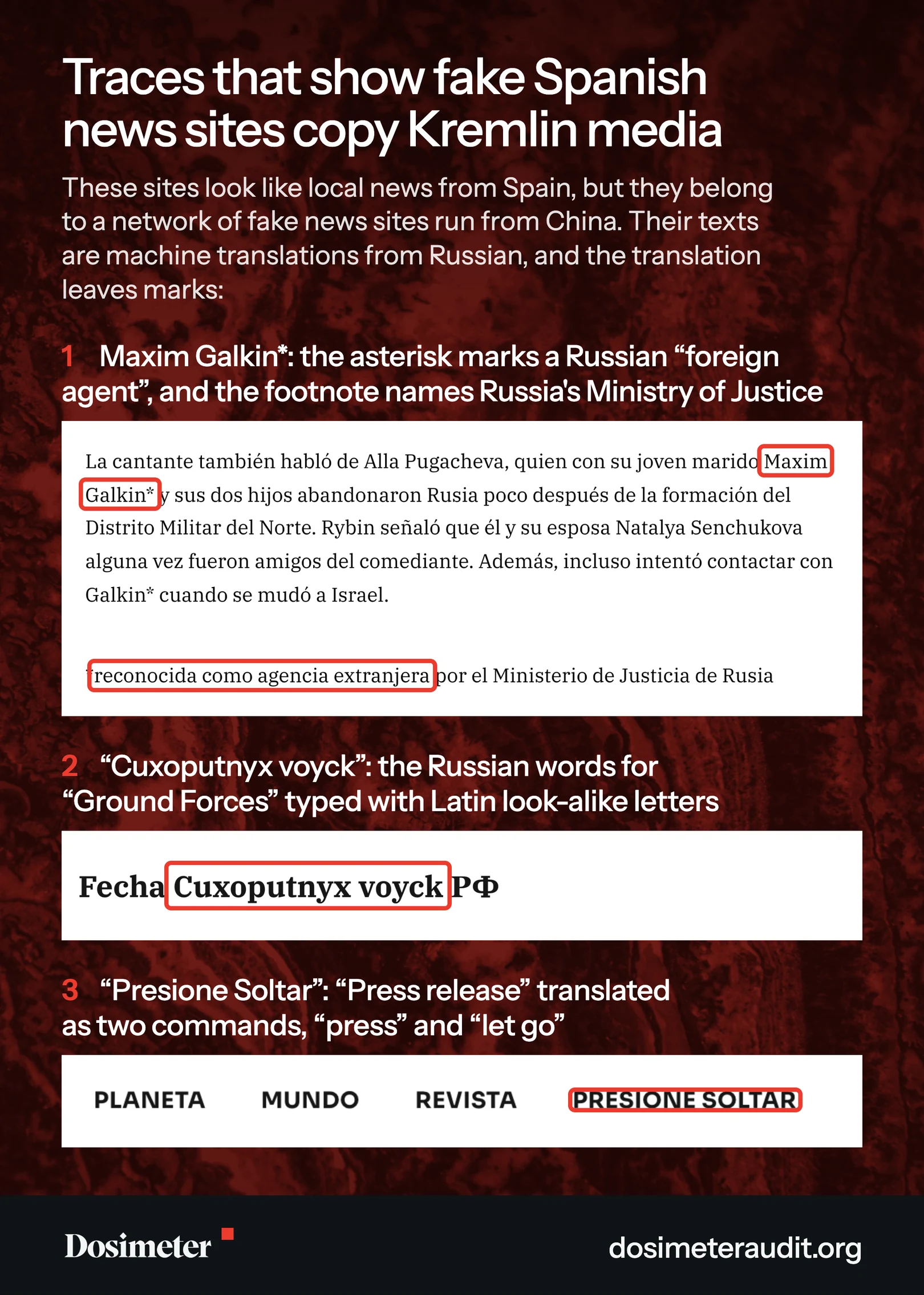
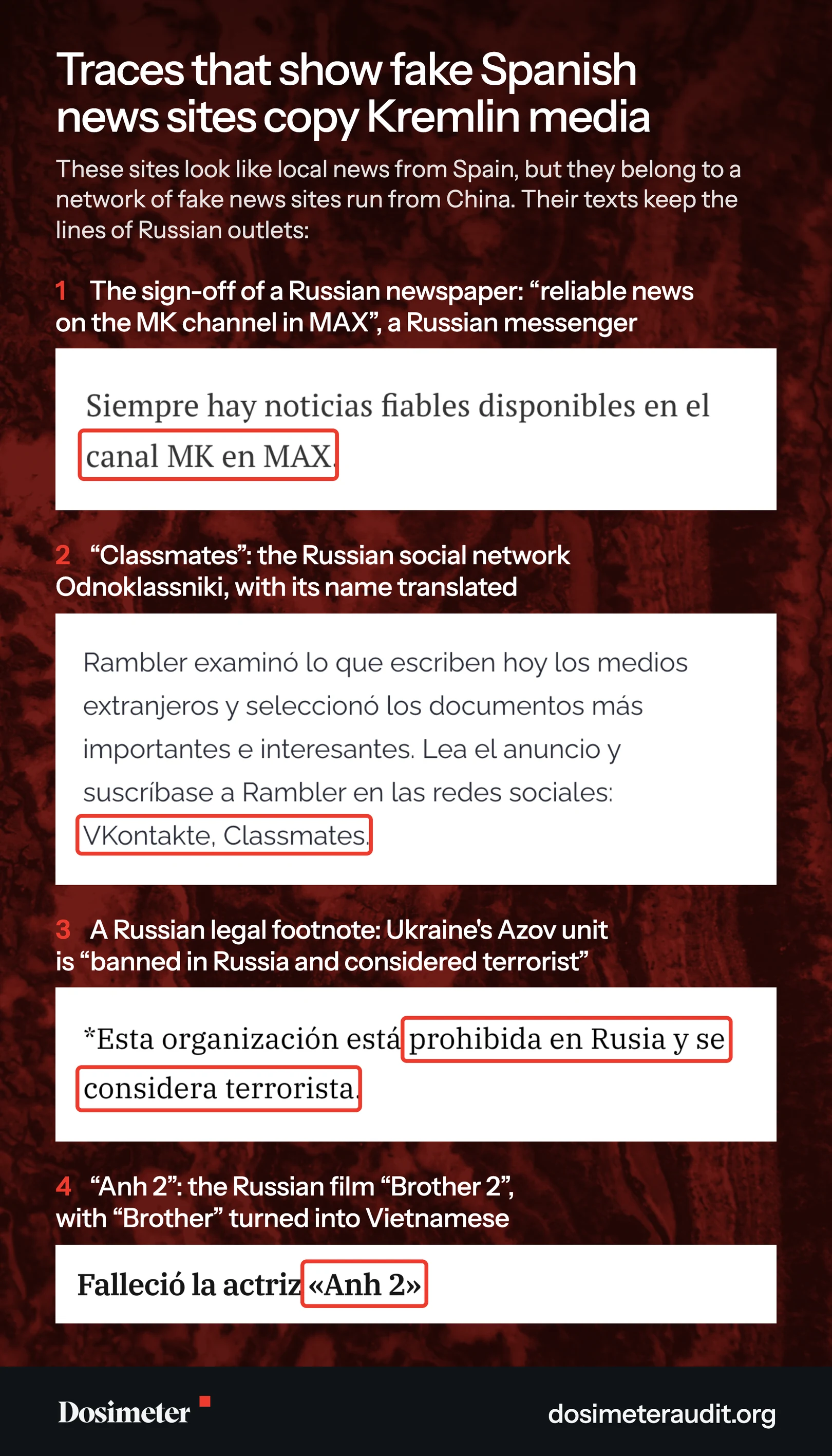
- Machine translation leaves Russian traces, from the word “SVO” to the sign-off lines of Russian outlets
- Bing and Google show these sites, and AI assistants find them there
The post cites a Russian outlet or state body, or keeps the sign-off line of a Russian outlet
- andregaceta.comColombia25.7%
- guellherald.comBarcelona, Spain21.8%
- sanrafaelscoop.comSan Rafael, Chile19.6%
- cordovapress.orgCórdoba, Spain19.2%
- lujanexpresar.comLuján, Argentina18.4%
- olmecpress.comMexico18.4%
- teotihuacaneco.comTeotihuacán, Mexico18.2%
- xochimilcolife.comXochimilco, Mexico17.2%
- sevillatimes.comSeville, Spain16.9%
- tarragonapost.comTarragona, Spain16.8%
- martapost.comSanta Marta, Colombia15.5%
- doloreshoy.coDolores, Colombia14.2%
- laplatapost.comLa Plata, Argentina13.3%
- lguazu.comIguazú, Argentina13.1%
Data: GitHub
2 · Context
A Chinese network of fake local news sites
Citizen Lab found at least 123 websites of this network in 30 countries in 2024, all run from China3.
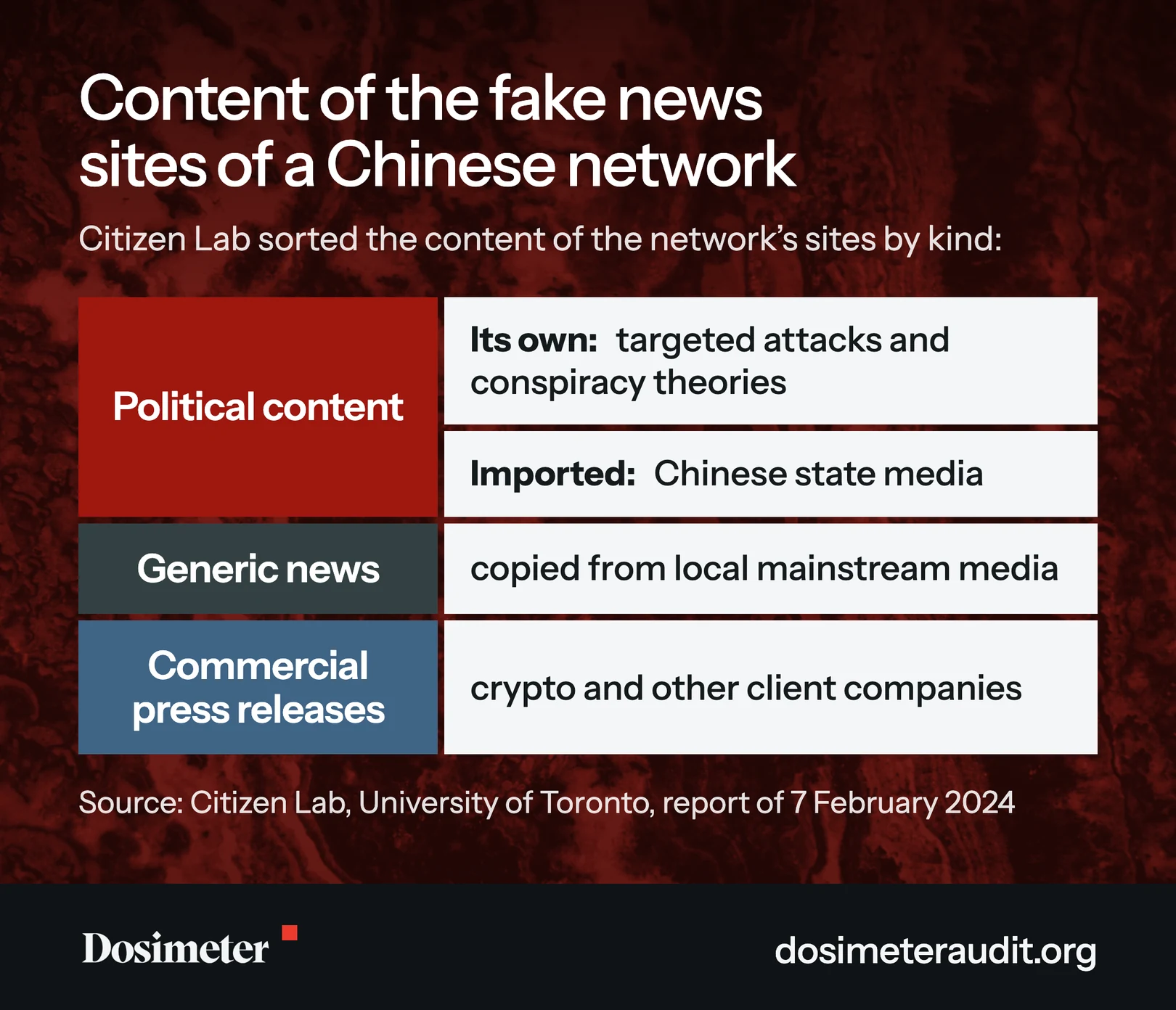
Dosimeter drew the diagram from the report of Citizen Lab, 7 February 2024
In 2026, the EEAS found that many of these sites now publish translations of Russian state media1. Before Spain's election, the four Spanish sites published Kremlin media on protests in Spain, on Pedro Sánchez and on the vote.
3 · Examples
Kremlin disinformation on fake Spanish news sites
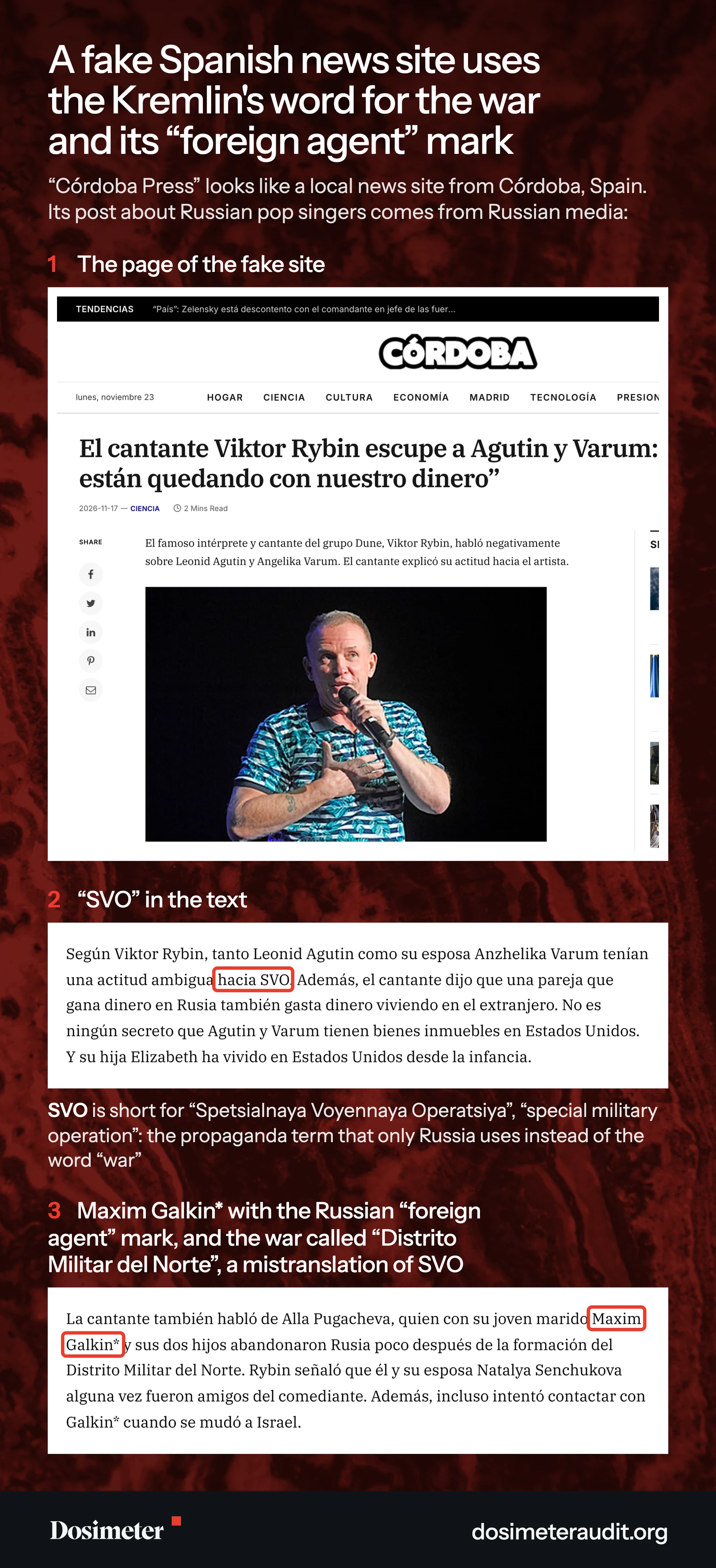
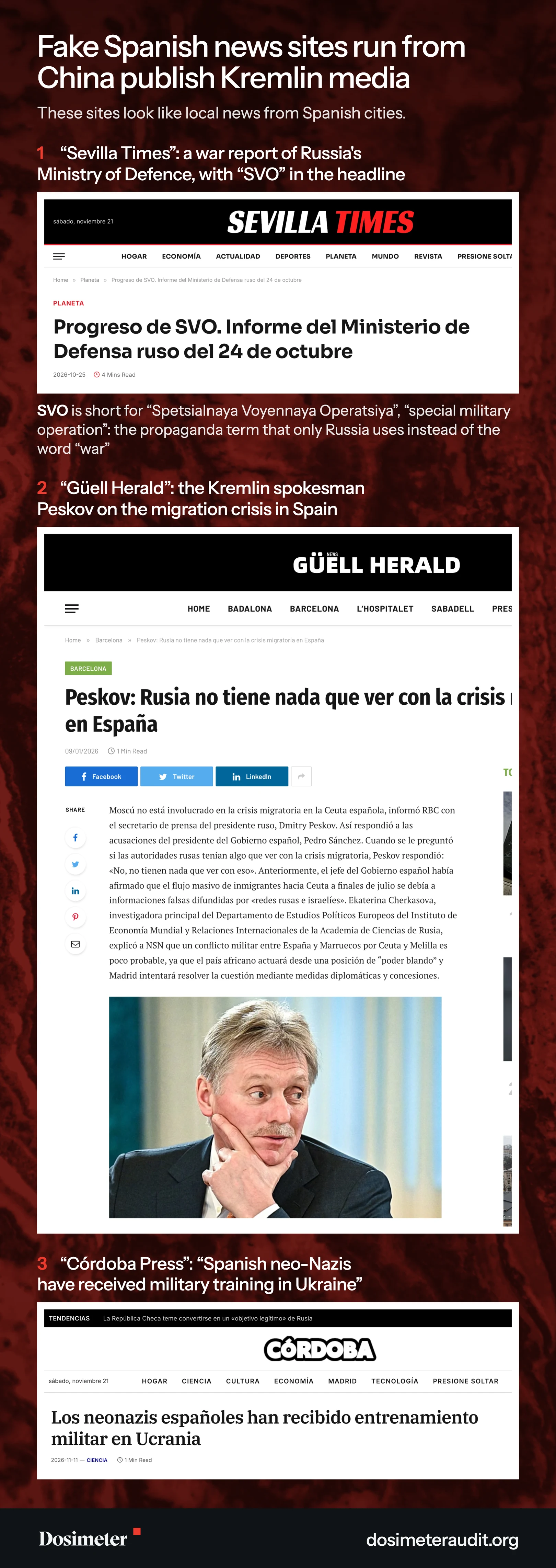
- Córdoba Press: “Spanish neo-Nazis have received military training in Ukraine”, with the Russian footnote that Azov is “terrorist” (archive copy)
- Güell Herald: “Peskov: Russia has nothing to do with the migration crisis in Spain” (archive copy)
- Córdoba Press: “Pogroms in Spain”, by a commentator of the Russian TV channel MIR 24, with the election of 29 November in the text
- martapost.com (Colombia): “Naryshkin announced the discovery of European soldiers on the battlefield in the Northern Military District” (archive copy)
- Córdoba Press: Maxim Galkin with the Russian “foreign agent” asterisk (archive copy)
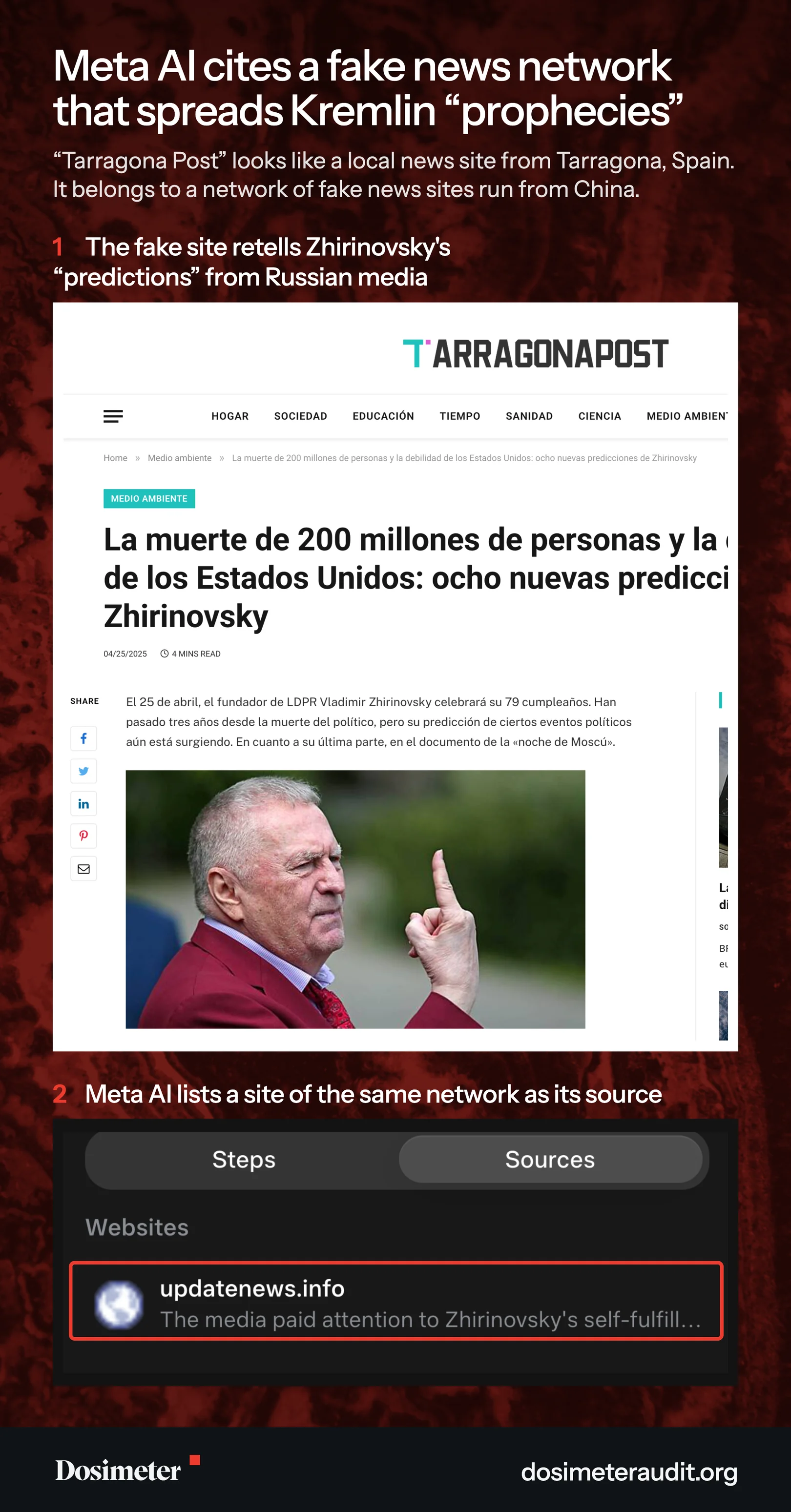
- Tarragona Post: “Eight new predictions of Zhirinovsky” (archive copy)
Meta AI cited a Zhirinovsky “prophecy” from updatenews.info, a site of the same network3. In the search that Meta AI shows next to its answer, the Tarragona Post page came first.
The network sets up its sites in batches: Güell Herald and Tarragona Post started on the same day in 2022 with the same press release of the Chinese state broadcaster CGTN (China Global Television Network).
4 · Machine translation
Traces of the Russian originals
- 147 posts write “SVO”, the Kremlin's term for the war, and 73 turn it into “Northern Military District”
- 181 posts keep the sign-off of the Russian newspaper Moskovsky Komsomolets about its channel in the Russian messenger MAX
- 134 posts keep the sign-off of Rambler with “VKontakte, Classmates”
- 1,674 posts write “Vladimir Zelensky”, the Russian form of the name, and 351 posts say “Kyiv regime”
- “Anh 2” stands for the Russian film “Brother 2” (archive copy), and “Cuxoputnyx voyck” for the Russian “Ground Forces” (archive copy)
5 · Search and AI
Bing, Google and Meta AI
AI assistants find their sources through Bing and Google4. Bing shows new posts of these sites within hours. When Dosimeter searched the exact titles of 16 posts, Bing showed only these sites and no other outlet.
Put simply, a “data void” is a question that currently has no serious answers on the internet. Michael Golebiewski at Microsoft5 coined the term in 2018 for search engines6, and now the term is used for AI systems too. In 2025, Alyukov and colleagues found that chatbots cite Kremlin disinformation where reliable information is missing7.
6 · “Triad of disinformation”
Russian, Chinese and Iranian state media on the same pages
In 2020, Clint Watts of the Alliance for Securing Democracy called the messaging of Russia, Iran and China a “triad of disinformation”8. Since then, their state media have signed cooperation agreements:
- TASS and Xinhua, 20259
- China Media Group with Russian state television and Russia Today, 202510
- China Media Group and the Islamic Republic News Agency (IRNA) of Iran, 202511
- Xinhua and the Iranian Mehr Media Group, 202412
On the “Slopeño” sites, Russian sources appear in 13.1% to 25.7% of a site's posts, Chinese state media in 1.2% to 2.2% and Iranian state agencies in 0.3% to 1.1%.
7 · Method
Data collection
- Sites: the 14 sites in Spanish from the list of Paperwall domains that Citizen Lab published in 2024
- Posts: about 1,500 of the newest posts per site, 20,996 in all, read on 21 November 2026 from the open WordPress list of posts
- Russian source: the post names a Russian outlet or state body, or keeps the sign-off line of a Russian outlet; the full list is in the description of the data
- Search engines: exact titles of posts in Bing and searches for the sites in Google, 21 November 2026
- AI assistants: questions in Spanish in new chats, 21 and 22 November 2026, location Spain
- Archive: the pages linked in this study are saved in the Wayback Machine
8 · Open data
Data for independent verification
The tables of the 14 sites and the 20,996 posts, 18 example posts with archive copies and a script that recounts the shares are on GitHub.
Get the next measurement of Dosimeter by email
References
- European External Action Service (March 2026), 4th EEAS report on foreign information manipulation and interference threats, pages 30 and 34
- Merriam-Webster, Slop, Merriam-Webster.com Dictionary, word of the year 2025
- Fittarelli, A. (7 February 2024), PAPERWALL: Chinese websites posing as local news outlets target global audiences with pro-Beijing content. Citizen Lab Report No. 174, University of Toronto
- Axios (18 April 2024), Meta releases new AI models and updates AI assistant
- Golebiewski, M. and boyd, d. (2019), Data voids: where missing data can easily be exploited. Data & Society
- Norocel, O. C. and Lewandowski, D. (2023), Google, data voids, and the dynamics of the politics of exclusion. Big Data & Society
- Alyukov, M., Makhortykh, M., Voronovici, A. and Sydorova, M. (15 October 2025), LLMs grooming or data voids? LLM-powered chatbot references to Kremlin disinformation reflect information gaps, not manipulation. Harvard Kennedy School Misinformation Review
- Watts, C. (15 May 2020), Triad of disinformation: how Russia, Iran, & China ally in a messaging war against America. Alliance for Securing Democracy, German Marshall Fund of the United States
- TASS (2 September 2025), TASS and Xinhua sign a strategy of cooperation for 2026-2030
- CGTN (9 May 2025), China Media Group signs multiple cooperation documents with Russian institutions
- Lingua Sinica. China Media Group and the Islamic Republic News Agency (IRNA), cooperation memorandum of 2 September 2025
- Tehran Times (16 October 2024), Mehr Media Group signs MoU with Xinhua News Agency